Home-based tDCS for depression: our research so far
One strand of my digital health research looks at transcranial direct current stimulation (tDCS) as a treatment for depression. tDCS delivers a weak electrical current to the prefrontal cortex through a wearable headset. What makes it interesting for health services is that patients can use it at home, without travelling to a clinic for every session.
I lead the data analysis in a collaboration with Flow Neuroscience and NHS partners, studying how well self-administered tDCS works outside the controlled conditions of a lab. Real-world usage data is messy and large, and that is exactly why it matters: it tells us how a treatment performs when real patients fit it into real lives.
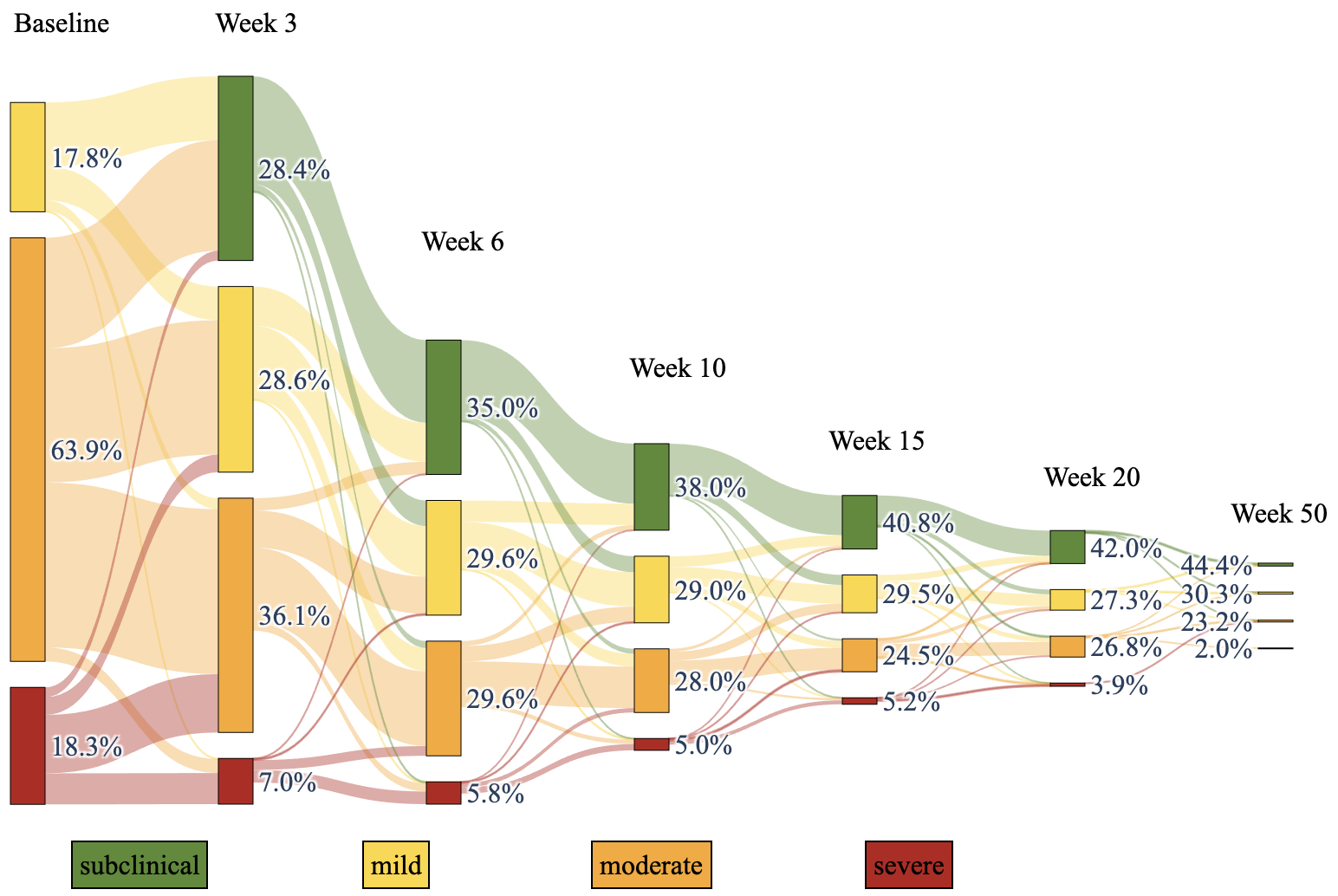
The figure above, from our retrospective cohort study, tracks how users’ depression severity shifted over 50 weeks of home use. The severe group shrank from 18.3% at baseline to 2.0% by week 50, while the share of users reaching subclinical levels grew steadily to 44.4%.
Published work
Three journal papers have come out of this collaboration so far:
- Mu, M., Banazadeh, A., Cauchi, M. and Griffiths, C., “Real-World Effectiveness of Self-Administered Transcranial Direct Current Stimulation (tDCS) for Depression: A Retrospective Cohort Study”, Journal of Affective Disorders Reports, 2026. doi.org/10.1016/j.jadr.2026.101044
- Griffiths, C., Banazadeh, A. and Mu, M., “Transcranial Direct Current Stimulation (tDCS) Used at Home for People with Self-Reported Depression: Impact on Self-Reported Concentration Problems”, Open Journal of Depression, December 2025.
- Maravic da Silva, K., Griffiths, C., Banazadeh, A. and Mu, M., “Transcranial Direct Current Stimulation (tDCS) Used at Home for People with a Diagnosis of Depression: Sleep Quality Outcomes”, Open Journal of Psychiatry, April 2025.
The retrospective cohort study is the largest piece to date, examining effectiveness across people who self-administered the treatment at home. The other two papers look at specific outcomes that matter to people living with depression: concentration and sleep quality.
The full list of my papers is on the publications page. If you work in mental health services and are interested in this line of research, email me.