Yoana Slavova is a third-year BSc Business Computing student at the University of Northampton. Yoana recently carried out some background research on utilising virtual reality in higher education f…
ACM TVX 2017 WiP CFP online

Dr Elena Fedorovskaya (Rochester Institute of Technology, USA) and I are organising the Work-in-Progress session of ACM TVX 2017, to be held in the Netherlands this June. The call for paper is now online.
What’s ACM?
Association for Computing Machinery, the world’s largest educational and scientific computing society, delivers resources that advance computing as a science and a profession. ACM provides the computing field’s premier Digital Library and serves its members and the computing profession with leading-edge publications, conferences, and career resources. [1] In the area of computer networks and multimedia, ACM has been very successful in supporting prestigious conferences while IEEE still dominates high impact journals.
What’s ACM TVX?
ACM TVX is the leading international conference for research into online video, TV interaction and user experience. It is the successor of the very successful EuroITV series (technically sponsored by ACM Special Interest Groups). TVX bridges human-computer interaction research (supported by ACM SIGCHI) and technology advancement in multimedia systems (supported by ACM SIGMM). As a multi-disciplinary conference, its aim is to foster discussions and innovative experiences amongst the academic research community and industry. [2]
What’s Work-in-Progress?
WiP encourages researchers, students and practitioners to submit research papers based on their recent viewpoints, new discoveries, and early-stage design and development in disciplines that are in line with TVX’s areas of interest. The WiP session provides a unique opportunity for exchanging brave new ideas, receiving feedback and fostering collaborations. We expect many WiP papers to grow into full submissions in the following iteration of TVX.
What’s new about WiP this year?
This year, we expanded the assessment criteria to include not only scientific impact but also societal, economic and industrial impact. In another word, we want to see something cool but also useful and feasible in practice. We also introduced a Project-in-Progress special track, soliciting contributions from ongoing major research initiatives including European Commission-funded or other similar-scale projects for cross-project discussions.
What’s the h-index and acceptance rate of ACM TVX?
TVX is only 3 years old, so we need to wait a bit longer to see its citation index. It is a highly competitive venue with an acceptance rate of ~25%.
[1] http://www.acm.org/about-acm
[2] https://tvx.acm.org/2017/
Lightning speed IEEE J-STSP
You have to give it up for the IEEE Journal of Selected Topics in Signal Processing. I only sent them the final version on Thursday last week. Less than two working days later, it’s now online for Early Access. 🙂
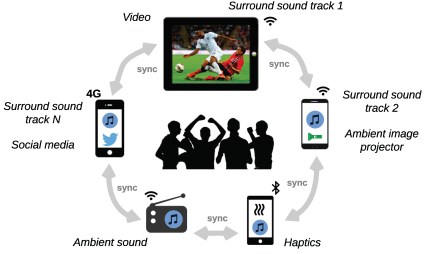
It has been a great pleasure working on this subject with a great team. It’s hard to think of something more exciting than seeing people with expertise and experiences in mathematics, user experience, psychological effects, programmable networks, or latest web technologies to work together. The work will be a cornerstone of my research in multi-sensory and multi-device immersive experiences. It also links to my recent endeavour in gaming and virtual reality.
Mu, M., Fawcett, L., Bird, J., Jellicoe, J., Simpson, S., Stokking, H., and Race, N. “Closing the Gap: Human Factors in Cross-device Media Synchronization”, in IEEE Journal of Selected Topics in Signal Processing, Feb 2017. DOI: 10.1109/JSTSP.2016.2638358
Paper accepted by IEEE IM 2017

Fawcett, L., Mu, M., Broadbent, M., Hart, N., and Race, N., SDQ: Enabling Rapid QoE Experimentation using Software Defined Networking, in Proceedings of IFIP/IEEE International Symposium on Integrated Network Management (IEEE IM), Lisbon, Portugal, 5/2017
Abstract: The emerging network paradigm of Software Defined Networking (SDN) has been increasingly adopted to improve the Quality of Experiences (QoE) across multiple HTTP adaptive streaming (HAS) instances. However, there is currently a gap between research and reality in this field. QoE models, which offer user-level context to network management processes, are often tested in a simulation environment. Such environments do not consider the effects that network protocols, client programs, and other real world factors may have on the outcomes. Ultimately, this can lead to models not functioning as expected in real networks. On the other hand, setting up an experiment that reflects reality is a time-consuming process requiring expert knowledge. This paper shares designs and guidelines of an SDN experimentation framework (SDQ), which offers rapid evaluation of QoE models using real network infrastructures.
Take ACM Multimedia to classes

I used about 30 minutes of lecture time going through some state-of-the-art research outcomes presented at ACM Multimedia 2016 conference. Students seemed to enjoy it and some even tried to download the paper for more details of the research.
A keyword of this year’s ACM MM is deep learning and there have been some interesting discussions on whether we are truly learning anything through deep learning or merely engineering some increasingly complex CNNs to get some jobs done…
Courtesy to the rightful researchers.
We won the Innovation Fund.
http://myvrlearning.wordpress.com
Project title: Transforming online learning experience using virtual reality and gamification.
At UoN, the Innovation Fund has been established by the Vice Chancellor as a way of promoting innovation from amongst staff through the funding of projects which will support Strategic or Operational Plan objectives or whose work contributes towards Northampton’s Changemaker Challenges.
LinkedIn:”You appeared in newscientist.com”
LinkedIn kindly found an article on New Scientist that quotes my comments on near-ultrasound communication (and subsequently spammed all my contacts…). It’s a cool piece of technology and I am glad to praise for its great potential.
IEEE ICME Bitmovin Grand Challenge Award
Well, it turned out that we were not just invited to present our work at the Bitmovin Grand Challenge at IEEE ICME conference, we actually won it!
https://bitmovin.com/icme2016grandchallenge/

Santander Staff Research Award
Two of my proposals entitled: Software defined wireless networking and Multimedia alternate realities have won the Santander Staff Research Award at the University of Northampton.

IEEE Interest Group on Quality of Experience for Multimedia Communications
IEEE Interest Group on Quality of Experience for Multimedia Communications posted my “QoE Pitch”:
https://sites.google.com/site/ieeeqoeig/

 Dr Mu Mu