Lightning speed IEEE J-STSP

You have to give it up for the IEEE Journal of Selected Topics in Signal Processing. I only sent them the final version on Thursday last week. Less than two working days later, it’s now online for Early Access. 🙂

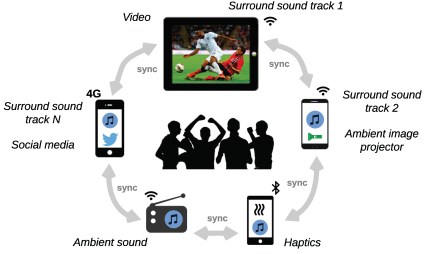
It has been a great pleasure working on this subject with a great team. It’s hard to think of something more exciting than seeing people with expertise and experiences in mathematics, user experience, psychological effects, programmable networks, or latest web technologies to work together. The work will be a cornerstone of my research in multi-sensory and multi-device immersive experiences. It also links to my recent endeavour in gaming and virtual reality.

Mu, M., Fawcett, L., Bird, J., Jellicoe, J., Simpson, S., Stokking, H., and Race, N. “Closing the Gap: Human Factors in Cross-device Media Synchronization”, in IEEE Journal of Selected Topics in Signal Processing, Feb 2017. DOI: 10.1109/JSTSP.2016.2638358
usecase3.jpg

Paper accepted by IEEE IM 2017

im2017-2

Fawcett, L., Mu, M., Broadbent, M., Hart, N., and Race, N., SDQ: Enabling Rapid QoE Experimentation using Software Defined Networking, in Proceedings of IFIP/IEEE International Symposium on Integrated Network Management (IEEE IM), Lisbon, Portugal, 5/2017

Abstract: The emerging network paradigm of Software Defined Networking (SDN) has been increasingly adopted to improve the Quality of Experiences (QoE) across multiple HTTP adaptive streaming (HAS) instances. However, there is currently a gap between research and reality in this field. QoE models, which offer user-level context to network management processes, are often tested in a simulation environment. Such environments do not consider the effects that network protocols, client programs, and other real world factors may have on the outcomes. Ultimately, this can lead to models not functioning as expected in real networks. On the other hand, setting up an experiment that reflects reality is a time-consuming process requiring expert knowledge. This paper shares designs and guidelines of an SDN experimentation framework (SDQ), which offers rapid evaluation of QoE models using real network infrastructures.

Take ACM Multimedia to classes

img_3133

I used about 30 minutes of lecture time going through some state-of-the-art research outcomes presented at ACM Multimedia 2016 conference. Students seemed to enjoy it and some even tried to download the paper for more details of the research.

A keyword of this year’s ACM MM is deep learning and there have been some interesting discussions on whether we are truly learning anything through deep learning or merely engineering some increasingly complex CNNs to get some jobs done…

Courtesy to the rightful researchers.

We won the Innovation Fund.

http://myvrlearning.wordpress.com

Project title: Transforming online learning experience using virtual reality and gamification.
At UoN, the Innovation Fund has been established by the Vice Chancellor as a way of promoting innovation from amongst staff through the funding of projects which will support Strategic or Operational Plan objectives or whose work contributes towards Northampton’s Changemaker Challenges.

LinkedIn:”You appeared in newscientist.com”

LinkedIn kindly found an article on New Scientist that quotes my comments on near-ultrasound communication (and subsequently spammed all my contacts…). It’s a cool piece of technology and I am glad to praise for its great potential.

https://www.newscientist.com/article/mg23230952-900-tv-shows-could-use-ultrasound-to-send-bonus-extras-to-your-phone/

https://www.newscientist.com/article/2110762-your-homes-online-gadgets-could-be-hacked-by-ultrasound/

ACM AltMM 2016 | Multimedia Alternate Realities

I have been invited to join the programme committee of AltMM 2016 (Multimedia Alternate Realities), an workshop at ACM Conference on Multimedia (October 15-19, 2016 . Amsterdam, The Netherlands). It’s an exciting new workshop that explores how the synergy between multimedia technologies and effects can foster the creation of alternate realities and make their access an enriching, valuable and real experience.

The submission deadline is 1st July 2016 and the author guideline is available at http://altmm2016.di.fc.ul.pt

Workshop Chairs
Teresa Chambel, LaSIGE, Faculdade de Ciências, Universidade de Lisboa, Portugal
Rene Kaiser, Joanneum Research, Austria
Omar Aziz Niamut, TNO, The Netherlands
Wei Tsang Ooi, National University of Singapore, Singapore
Judith A. Redi, Delft University of Technology, The Netherlands

Program Committee(to be completed)
Abdelwahab Hamam, Immersion Inc, USA
Adrian Cheok, Imagineering Institute, Iskandar Malaysia
Britta Meixner, FXPAL, USA
Cha Zhang, Microsoft Research, Redmond, USA
Graham Thomas, BBC, UK
Kuan-Ta Chen, Academia Sinica, Taiwan
Letizia Jaccheri, Norwegian University of Science and Technology, Norway
Marian Ursu, University of York, UK
Marianna Obrist, University of Sussex, UK
Mika Tuomola, Politecnico di Milano, Italy
Mu Mu, University of Northampton, UK
Nimesha Ranasinghe, NUS, Singapore
Nuno Correia, New University of Lisbon, Portugal
Pablo Cesar, CWI, The Netherlands
Paula Viana, Polytechnic of Porto and INESC TEC, Portugal
Ryohei Nakatsu, NUS, Singapore
Santosh Basapur, Institute of Design, IIT, USA
V. Michael Bove, MIT Media Lab, USA
Wendy van den Broeck, Vrije Universiteit Brussel, Belgium